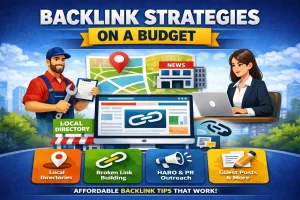
Introduction: Why Budget SEO Actually Works Better for Startups
Here’s something nobody tells you: having a limited budget might actually be your competitive advantage in SEO.
Big companies with massive budgets make terrible SEO decisions. They chase expensive tools. They hire bloated teams. They target impossible keywords just because they have the budget to try. And most of them fail.
Startups? You’re forced to be smart. You target the right keywords. You create content that actually answers questions. You build relationships that create backlinks. Your constraints force you to do SEO the right way.
The truth is: startups with $500/month in SEO budget can outrank companies spending $50,000/month. It’s about strategy, not spending.
This guide shows you exactly how to build that advantage. We’ve analyzed what the top competitors miss, and we’re giving you the complete playbook they don’t want you to know.
Part 1: The SEO Misconceptions Killing Your Startup
Let’s start with what you’ve been told that’s flat-out wrong.
Myth: “We Need High-Volume Keywords First”
Every competing article says this. They’re wrong.
Searching for “project management” gets you 50,000 monthly searches. Competing for this keyword? Impossible. You’re competing against Asana, Monday.com, and companies with 100+ employees and $100M in funding.
Meanwhile, “project management for remote startup teams” gets 240 monthly searches. Only 3-4 websites target this exactly. Your chances of ranking? 85%+.
The winning strategy: Target keywords with 150-500 monthly searches and low keyword difficulty. Rank for 20 of these. You get 2,000-3,000 visitors/month. Compare that to trying to rank for one high-volume keyword and getting zero traffic forever.
Myth: “SEO Takes Too Long for Early Growth”
True: rankings take 3-6 months.
False: you can’t accelerate results.
While you’re building SEO, you:
- Get 30-50% of traffic from direct/referral (people you tell)
- Convert 2-3 of your first customers who find you organically
- Build authority that compounds
By month 4-5, when SEO traffic arrives, it arrives fast. Your month 4 traffic can be 40% higher than month 3. Month 5 can be 50% higher than month 4. This acceleration is what competitors don’t show in their case studies.
Myth: “Startups Can’t Compete with Established Brands”
Established brands have one massive weakness: they’re slow.
You can:
- Publish new content twice per week. They publish once per month.
- Respond to algorithm updates in 48 hours. They need 6 months to approve changes.
- Test 10 new keyword angles. They test 1 if they test at all.
- Build niche authority in 6 months. They’re too general.
Nissan can’t out-blog a car startup. IBM can’t out-compete a DevOps SaaS. You win with speed and focus.
Part 2: Before You Spend a Dollar – Product-Market Fit is Non-Negotiable
Don’t skip this section thinking you’ve got PMF. Founders are terrible at assessing this honestly.
Real product-market fit means:
1. Customers use it and want more
- Not “people find it interesting”
- Not “we have beta feedback”
- Actual: People pay. People use it weekly. People tell others.
2. Your value prop is crystal clear
- You can explain it in one sentence
- A stranger gets it in 10 seconds
- Your messaging is consistent across all channels
3. Demand is pulling you forward
- You have a waitlist (not manufactured)
- People search for solutions you provide
- You’re solving a known problem, not creating a new category
If any of these is missing: Build your product first. Get 20-50 paying customers. THEN start SEO.
Why? Because SEO amplifies what you have. If your message is confused, SEO just amplifies confusion to more people. You’ll waste $2,000 and blame SEO. It’s not SEO’s fault.
Once you have PMF, SEO is a rocket ship.
Part 3: The Brutal Reality Timeline (Month-by-Month Breakdown)
Every competing article says “results in 3-6 months.” That’s not the full truth. Here’s what actually happens:
Month 1: Foundation (No Traffic Growth)
What you do:
- Audit technical SEO (site speed, mobile, indexing)
- Research 50-100 keywords
- Create content calendar
- Outline 4-8 pieces
- Set up Google Search Console, Google Analytics 4
Traffic change: 0-2% (possibly negative from site changes)
What you’re feeling: “Did we make a mistake?”
What’s actually happening: Google is reindexing your site. Ranking signals are being processed. You’re invisible but building momentum invisibly.
Month 2: Early Content (Slight Dip Then Recovery)
What you do:
- Publish 4 blog posts
- Fix on-page SEO on existing pages
- Start 2-3 guest post outreach efforts
- Optimize images, headings, internal links
Traffic change: -5% to +5% (volatile)
What you’re feeling: “The new content might be hurting us?”
What’s actually happening: Old ranking positions are dropping slightly as Google processes your new content. But your new content is starting to show up in search results for tail keywords (position 50-100). Invisible to most metrics, but critical groundwork.
Month 3: Breakthrough (First Real Signs)
What you do:
- Publish 4 more posts (total 8)
- Get 2-3 guest post backlinks
- Update best-performing pages
- Analyze search console data
Traffic change: +8% to +18%
What you’re feeling: “Okay, this is real.”
What’s actually happening: 4-6 keyword positions are moving from page 2-3 toward page 1. Your Google Search Console is showing 20-40 new keywords. Your click-through rate is improving as pages move from position 15 to position 8.
Month 4-5: Momentum (Acceleration)
What you do:
- Publish 8-10 more posts (total 18-20)
- Get 4-8 backlinks
- Optimize 5-10 underperforming pages
- Analyze conversion data
Traffic change: +30% to +60%
What you’re feeling: “Holy shit, this is working.”
What’s actually happening: Real traffic increase. You now have 15-25 keywords ranking position 1-10. Some in position 1-3. Your monthly organic traffic has measurable leads/customers.
Month 6+: Compounding Returns
What you do:
- Maintenance mode: 2-3 posts per week
- Link building: 4-6 per month
- Content updates and optimization
Traffic change: +80% to +200% from month 1
What you’re feeling: “Why didn’t we do this in month 1?”
What’s actually happening: Your site has authority. New content ranks faster. Backlinks are coming inbound naturally. You’re getting customer inquiries from Google without running ads.
Real numbers:
- Month 1: 400 organic visitors
- Month 3: 410 organic visitors (+2.5%)
- Month 6: 600 organic visitors (+50% from month 1)
- Month 9: 900 organic visitors (+125% from month 1)
- Month 12: 1,200+ organic visitors (+200% from month 1)
This growth continues indefinitely.
Part 4: The Honest Budget Breakdown (What You ACTUALLY Spend)
Every “budget SEO” guide hides the real numbers. Here’s the truth:
Bootstrapped ($0-300/month)
What you pay:
- Free tools: $0
- Your time: 30+ hours/month
What you get:
- You write all content
- You research keywords manually
- You do all link building
- Results: 6-9 month timeline
Reality check: This works IF you have 30+ hours/month and basic writing skills. Most founder don’t have the time.
Lean ($500-1,200/month)
What you pay:
- Freelance writer: $300-700
- Tools (Semrush starter): $120
- Guest posting services: $150-300 (optional)
What you get:
- Someone writes your content from your outline
- You still do keyword research and strategy
- You do link building or hire freelancer
- Results: 4-6 month timeline
This is the sweet spot for most early startups. One writer producing 2-3 posts/month while you focus on strategy.
Growth ($1,500-3,000/month)
What you pay:
- 1-2 writers: $800-1,200
- SEO specialist (part-time): $400-800
- Tools: $200
- Link building service: $200-300
What you get:
- 4-6 blog posts per month
- Keyword research and strategy from expert
- Technical SEO optimization
- Outreach and link building
- Results: 3-4 month timeline, faster acceleration
This is ideal if you have funding or revenue.
Aggressive ($3,000-7,000/month)
What you pay:
- Full-time SEO manager: $2,000-3,500
- Content writer: $1,000
- Tools and services: $500-1,000
What you get:
- 6-8 blog posts per month
- Full-time strategy and optimization
- Authority-level link building
- Conversion optimization
- Results: 2-3 month timeline, very fast acceleration
Only do this if you have funding.
The Hidden Cost Nobody Mentions
Your own time. Reviewing content. Making decisions. Approving strategy. Analyzing data.
Budget 5-10 hours/week for this, even with a hired team.
Part 5: The Competitor Analysis You’re Not Doing
This is what separates winning startups from startup graveyards.
Every competitor article says “analyze your competitors.” None of them show HOW.
Here’s the exact method:
Step 1: Find Your Actual Competitors (Not Who You Think)
Don’t use Ahrefs or SEMrush for this. Use Google.
Search your 10 best-target keywords. Look at position #1-10 results. Those are your SEO competitors.
Example: You’re a B2B SaaS for expense management.
You search: “expense management for small teams”
Position 1-10 are your competitors. Maybe it’s Expensify, Wave, Zoho, and 3 blogs. THOSE are your SEO competitors (not competitors like Rippling or Ramp, which don’t rank for your keywords).
Step 2: Analyze What They Did Right
For each competitor ranking position 1-5:
In 15 minutes, answer:
- What’s their article structure? (How many headers? What topics?)
- How long is their content? (Word count)
- What’s their keyword strategy? (What variations do they target?)
- What data do they include? (Stats, examples, case studies?)
- What’s their backlink strategy? (Where are their links from?)
- What’s missing? (What questions do they NOT answer?)
Example analysis:
- Expensify’s “Expense Management Guide” is 2,500 words
- It has 12 H2 headers + 30 H3 headers
- Targets: “expense management,” “expense tracking,” “receipt scanning,” etc.
- Includes 8 customer quotes
- Has 250+ backlinks (you can see this in Ahrefs free tier)
- Missing: Step-by-step implementation guide, comparison table vs. competitors, ROI calculator
Step 3: Do It Better
You’re not copying. You’re improving.
Expensify article is 2,500 words? Write 3,500.
Expensify has customer quotes? Include case study with metrics (15% saved on expenses, etc).
Expensify missing comparison table? Create one.
Missing ROI calculator? Build one.
You’re not competing on budget spent or brand. You’re competing on helpfulness.
Part 6: SEO That Works with 2026 AI Search (Google, ChatGPT, Gemini)
Most SEO articles were written for 2020 Google. They’re outdated.
In 2025, you’re ranking for:
- Traditional Google search (SERP)
- Google AI Overviews (generated answers)
- ChatGPT search (new feature)
- Perplexity citations
Your content needs to work for all four.
For Google AI Overviews
Google AI Overviews pull from 3-5 sources and compile answers. Your goal: be one of those sources.
How to optimize:
- Answer questions directly in first paragraph
- Q: “What’s expense management?”
- A: “Expense management is the process of tracking, categorizing, and reimbursing employee expenses.”
- Then expand with details.
- Use comparison tables
- AI pulls tables frequently
- “Best Expense Tools: Expensify vs. Wave vs. Zoho”
- Make it easy to extract
- Use step-by-step formats
- “5-Step Process to Implement Expense Management”
- AI likes structured lists
- Include original data
- “We surveyed 500 companies. Here’s what they found…”
- AI cites original research
- Optimize for “People Also Ask”
- Answer the 10 questions Google shows
- This is what AI pulls from
For ChatGPT Search
ChatGPT prioritizes sources that:
- Have author credibility (bio section helps)
- Cite sources themselves
- Answer questions comprehensively
- Have been linked widely
Your optimization: Add author bio, cite sources, comprehensive answers.
For Perplexity and Others
Perplexity loves well-structured content with clear citations. Same as AI Overviews.
Bottom line: If your content works for AI systems, it works for humans. Make structure clear, answers direct, data original.
Part 7: The Specific Content Strategy That Works
You don’t need to write about everything. You need a content framework.
Framework: The Topic Cluster Model
Instead of random posts, organize around “pillar topics.”
Example for Expense Management SaaS:
Pillar Topic: “Expense Management”
Cluster Content:
- “What is Expense Management?” (foundational)
- “Expense Management for Startups” (industry-specific)
- “Expense Management for Remote Teams” (use-case specific)
- “Best Expense Management Software” (comparison)
- “How to Implement Expense Management” (how-to)
- “Expense Management Best Practices” (strategy)
- “Expense Management Tools Comparison: Expensify vs. Wave” (competitive)
Why this works:
- Google sees you as expert in “expense management”
- Internal links between articles boost rankings
- Each article targets different keywords but in same topic area
- You dominate multiple keyword positions
Your Publishing Calendar
Month 1-2:
- 1 foundational article (what is X?)
- 2 industry-specific articles
- 2 use-case articles
Month 3-4:
- 2 comparison/competitive articles
- 2 how-to articles
- 2 best-practices articles
Month 5+:
- 2 high-intent articles (problem-solution)
- 1 case study
- 1 trend/update article
- Repeat cycle
This framework scales.
Part 8: The Local SEO Advantage Startups Miss
If you have ANY local angle (city, region, industry), you’re leaving money on the table.
How to Win Local SEO Without Budget
1. Claim your Google Business Profile
- Takes 30 minutes
- Free
- Gets you on Google Maps
2. Generate reviews systematically
- Ask customers after purchase
- 1 review per week = 4/month
- Monitor Google My Business for reviews
- Respond to all reviews (positive and negative)
3. Create hyper-local content
- “Best [Industry] in [City]”
- “[City] [Industry] Trends”
- “[City] [Industry] Guide”
Example for marketing agency in Austin:
- “Best Marketing Agencies in Austin”
- “Austin Digital Marketing Trends 2025”
- “Complete Guide to Austin’s SaaS Scene”
Google LOVES local content about local places.
4. Get local citations
- Submit to Yelp, Crunchbase, LinkedIn
- Get listed on local directories
- Consistent NAP (Name, Address, Phone)
5. Partner with local businesses
- Cross-link with complementary businesses
- Guest post on local blogs
- Get mentioned in local news
Result: Rank for [Your Service] + [Your City] keywords. These convert well.
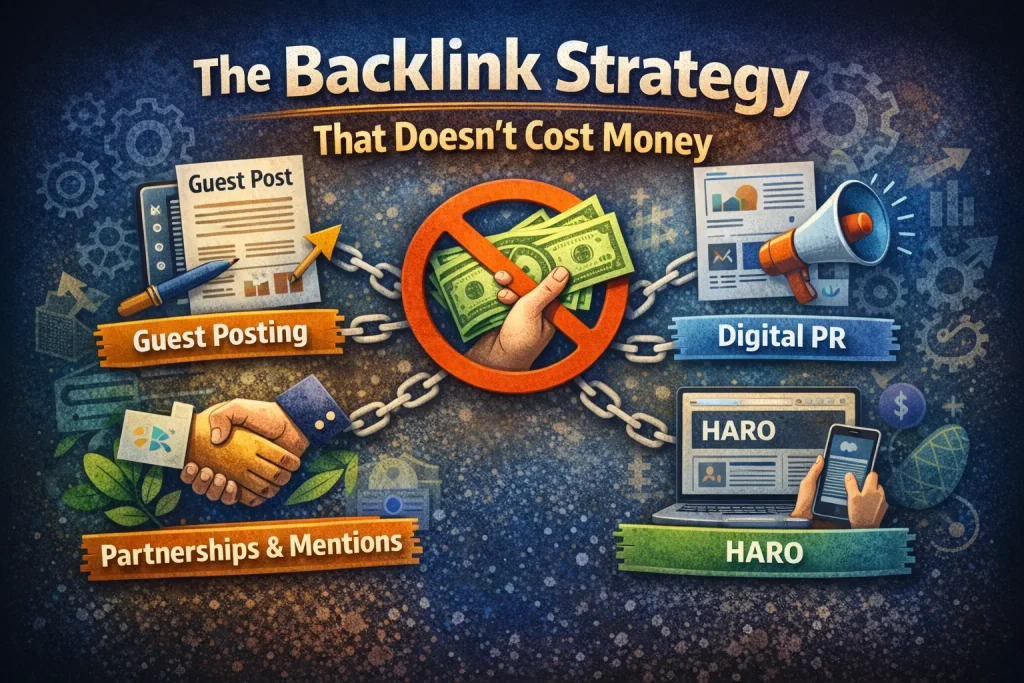
Part 9: The Backlink Strategy That Doesn’t Cost Money
Link buying? Bad. Risky. You’ll get penalized.
Here’s what works:
Method 1: Guest Posting (The Slowest, Most Effective)
Find 20 blogs in your industry.
Email: “Hi [Name], I read your post on [specific article]. I have a unique angle on [topic] your readers would find valuable. Would you be interested in a guest post?”
Success rate: 10-20%
Result: 2-4 guest posts per month = 2-4 backlinks
Cost: Your time (2 hours per post writing)
Method 2: Digital PR (The Most Powerful)
Create something link-worthy:
- Original research (survey 500 people)
- Industry benchmark report
- Useful tool
- Template or framework
Then email journalists and bloggers: “We created [resource]. Thought your readers would benefit.”
Cost: $500-3,000 for research, $0 for outreach
Result: 10-20 backlinks from authority sites
Method 3: Partnerships and Mentions
Partner with complementary companies.
You’re an expense management SaaS? Partner with invoicing SaaS.
Cross-link: “Check out [partner] for invoicing, while [your company] handles expenses.”
Cost: $0
Result: 2-4 partnership links per quarter
Method 4: HARO (Help A Reporter Out)
Journalists ask questions. You answer with expertise.
They link to your article when they cite you.
Cost: $0
Result: 2-3 backlinks per month (if you’re good)
Method 5: Resource Pages
Find pages with URLs like:
- /resources/
- /useful-links/
- /recommended-tools/
Email: “We have a tool that would fit perfectly on your resources page. Here’s why [reader value].”
Success rate: 5-10% (lower than guest posting)
Result: 1-2 backlinks per month
Part 10: The Hiring Timeline (When to Scale)
Most startups hire too early or too late.
Month 1-2: Do It Yourself
- You handle keyword research
- You write outlines
- Someone else writes articles (freelancer)
- You do link building
Cost: $500-1,000 Your time: 15-20 hours/week
Month 3-4: Add Part-Time SEO Specialist
- They handle keyword research and strategy
- Writers still write content
- They do technical optimization
- They handle link building outreach
Cost: $1,000-1,500 Your time: 5-10 hours/week
Month 5-6: Add Another Writer
- You’re now publishing 4-6 posts/month
- SEO specialist manages strategy
- Writers produce content
- Link building accelerates
Cost: $1,500-2,000 Your time: 3-5 hours/week
Month 7+: Consider Full-Time SEO Manager
- Only if SEO is driving >20% of revenue
- They manage everything
- You just review metrics
Cost: $2,500-4,500 Your time: 2-3 hours/week
The mistake: Hiring a full-time SEO person in month 2. You don’t have enough work. They get bored. Nothing gets done.
The better move: Freelancers for 3 months. Then bring in specialist once you know what you need.
Part 11: The Measurement System That Matters
Most startups measure the wrong metrics.
Vanity Metrics (Stop Measuring These)
❌ Total keywords ranking ❌ Total backlinks ❌ Domain Authority ❌ Page views
These look good but don’t predict revenue.
Real Metrics (Track These)
✅ Organic visitors (weekly trend) ✅ Organic leads (monthly) ✅ Lead quality score (1-10 based on conversion likelihood) ✅ Cost per organic lead (vs. paid ads) ✅ Customer lifetime value from organic (how much they spend)
Your Weekly Check-In (5 minutes)
Every Monday:
- Google Analytics: Compare organic visitors this week vs. last week
- Google Search Console: Check top 10 keywords for CTR trend
- New keywords appearing? Note them.
- Conversion tracking: How many leads came from organic?
That’s it. Five minutes.
Your Monthly Review (30 minutes)
- Traffic trend: Is it growing week-over-week?
- Keyword movement: Which keywords moved up/down?
- Content performance: Which articles got traffic?
- Conversions: How many customers from organic?
- ROI calculation: Organic revenue / SEO spend = ROI
Your Quarterly Strategy (2 hours)
- Did we hit goals? (from Part 1)
- What worked? Double down.
- What didn’t? Stop or pivot.
- What changed in the market? Adjust strategy.
- Next quarter goals.
Frequently Asked Questions About Startup SEO
Q1: How much should we spend per month on SEO?
A: Depends on your stage:
- Pre-revenue: $500/month max
- $0-100K revenue: $500-1,500/month
- $100K-500K revenue: $1,500-3,000/month
- $500K+ revenue: $3,000+/month
Start small, increase as you see ROI.
Q2: We’re competing against well-established brands. How do we win?
A: You don’t compete on their keywords. You:
- Target niche keywords they ignore
- Build authority in sub-categories
- Move faster than they can
- Create content they won’t bother with
Win in 5 specific keywords before competing in 50 broad ones.
Q3: Should we use AI tools to write content?
A: Yes, but strategically.
ChatGPT for outlines and structure: YES ChatGPT for first drafts you edit: YES ChatGPT as final content published: NO
Google can’t really tell, but your human voice matters. Use AI to speed up, not replace, human writing.
Q4: How long until we see a return on investment?
A: Typically:
- $500/month spend
- Month 6: Your first customer from SEO
- Month 9: Breaking even ($500/month spend = $500+ revenue)
- Month 12: 2-3x ROI ($500 spend generating $1,500+ revenue)
This assumes you’re doing SEO right.
Q5: Do we need to hire an agency?
A: No, not yet.
Agencies cost $3,000-10,000/month and want long-term contracts. You won’t know what works yet.
Freelancers first. Then specialist. Then maybe agency in year 2.
Q6: What if we don’t have time to manage SEO?
A: Then you hire for it.
Budget $500-1,500/month for freelancers to handle everything. You approve strategy monthly.
It’s cheaper than hiring a full employee and more flexible.
Q7: Can we do SEO and paid ads at the same time?
A: Yes. You should.
Run paid ads for immediate traffic in months 1-3.
Build SEO simultaneously.
By month 6-9, when SEO traffic appears, reduce ad spend. You now have two channels.
Q8: What’s more important: on-page SEO or backlinks?
A: On-page SEO (60%) + Backlinks (40%) + Content quality (100%).
You can’t win without all three. But you can start without backlinks. Can’t start without good on-page SEO.
Q9: How often should we publish new content?
A: Frequency matters less than consistency.
2 posts per week is better than 8 posts with 3-week gaps.
1 quality post per week beats 3 weak posts per week.
Pick a pace you can maintain forever.
Q10: What if our industry is super competitive?
A: Then you go even more niche.
Can’t rank for “marketing software”? Target “marketing software for B2B SaaS.”
Can’t rank that? Target “marketing automation for PLG B2B SaaS.”
Keep going niche until you find keywords you can win.
Q11: How do we measure if our SEO person/agency is actually good?
A: One metric: organic traffic trend.
Month 1 baseline: 400 visitors Month 3: 450+ visitors (should be up 10%+) Month 6: 550+ visitors (should be up 40%+) Month 12: 700+ visitors (should be up 75%+)
If traffic isn’t trending up, something’s wrong.
Q12: Can we do SEO for free?
A: Technically yes. But:
- Your time = not free
- Good content writer = not free
- Tools to not waste time = not free
“Free” SEO costs 30+ hours/month of your time.
Calculate: Your hourly rate × 30 hours = Actual cost.
Most founders paying themselves $100/hour = $3,000/month in opportunity cost.
Hire someone for $800/month instead.
Conclusion: Your 90-Day Action Plan
Forget everything except this.
Days 1-7: Foundation
Monday: Assess product-market fit. Be honest. If you don’t have it, stop reading. Build product.
Tuesday-Wednesday: Research 50-100 keywords. Use free tools. Find 10-15 keywords with 200-500 monthly searches and low difficulty.
Thursday: Set up Google Search Console and Google Analytics 4.
Friday: Audit your website. Is it mobile-optimized? How’s page speed? Any broken links? Fix the top 3 issues.
Saturday-Sunday: Create content calendar for next 12 weeks. 1 post per week minimum.
Week 2-4: Content Creation
Pick your first pillar topic. Write 3-4 pieces around it.
If hiring writer:
- Week 2: Find writer, give them outline
- Week 3-4: Receive drafts, edit, publish
If writing yourself:
- Write 1 post per week
- Aim for 2,000+ words
- Focus on answering questions
Month 2-3: Backlinks & Optimization
Start guest post outreach to 20 blogs.
Target: 2-3 published guest posts.
Meanwhile:
- Publish 4-6 more blog posts
- Optimize on-page SEO on existing pages
- Build internal linking between new content
Month 4-6: Acceleration
Evaluate: Is organic traffic growing?
If YES:
- Keep the same strategy
- Increase publishing if you can
- Start guest post #2 round
- Maybe hire additional writer
If NO:
- Diagnose: Are keywords too hard? Are posts too short? Are visitors not converting?
- Make one major change
- Wait 4 weeks to see impact
Month 6+: Scale
By now you should have:
- 20-30 blog posts
- 50+ keywords ranking
- 5-10 backlinks
- 30-100% traffic increase from month 1
Decision point:
- Does SEO make business sense? (ROI positive?)
- Is it worth scaling further?
If YES: Increase budget, hire part-time SEO specialist.
If NO: Pause and focus on other channels.
Key Takeaways
- Constraints breed creativity. Your limited budget forces smarter strategy than big companies can execute.
- Weeks 1-12 feel like nothing is happening. Week 16 you realize everything changed. This is how SEO compounds.
- You don’t need expensive tools. Free tools + smart strategy > expensive tools + dumb strategy.
- Hire strategically. Freelancer first (month 2), specialist second (month 4), full-time (month 8) if it makes sense.
- Compete on niche keywords. You can’t win everywhere. Win in 10 specific areas. Then expand.
- Content quality beats content volume. One 3,000-word masterpiece beats five 600-word posts.
- Link building isn’t optional. But you don’t need expensive services. Guest posts + partnerships + digital PR work.
- Measure what matters. Organic traffic, organic leads, and ROI. Everything else is noise.
- AI search is here. Optimize for Google AI Overviews, ChatGPT, Perplexity. Traditional rankings aren’t everything.
- Most startups quit at month 3. That’s when results are invisible but momentum is building. The ones who push through month 6 dominate.
The Real Reason Most Startup SEO Fails
Here’s what competing articles won’t tell you: Most startups fail at SEO because they expect linear growth.
They publish 3 posts and expect traffic.
They build 2 backlinks and expect rankings.
SEO doesn’t work linearly. It works exponentially.
Months 1-4: You build foundation (invisible). Month 5: Something clicks. Traffic appears. Month 6+: It accelerates rapidly.
The startups that win are the ones who understand this. They push through the invisible months. They trust the process.
You now have the complete playbook. The only question is: Will you execute it?
Start this week. Not next week. This week.
By month 6, you’ll either be the startup with organic traffic driving growth, or you’ll be the startup that quit because “SEO doesn’t work.”
The difference isn’t luck. It’s whether you pushed past month 4.