You receive a resume. The cover letter sounds perfect. Almost too perfect.
You read a blog post. Every sentence flows smoothly. Every paragraph transitions flawlessly. But something feels off.
You are managing your company’s content. You hired a writer. You need to know if they actually wrote the article or if they used AI.
You are an educator. Your student submitted an assignment. It reads like an expert wrote it. In 30 minutes.
This is the reality of 2026. AI-generated content is everywhere. It looks like human writing. It sounds like human thinking. But it is not.
The problem is not AI content itself. The problem is not knowing when you are reading it.
Undetected AI content erodes trust. It misleads customers. It falsifies academic integrity. It misrepresents authorship.
This guide shows you exactly how to detect AI written content. Not with a vague feeling. With concrete, actionable methods.
Part 1: Understanding AI Generated Content
Before you can detect AI content, understand how it works and why it looks human.
AI language models like ChatGPT, Claude, and Gemini predict word sequences. They calculate which word is most likely to come next. Then they predict the next word. Then the next. This creates sentences.
The result is fluent, grammatical, readable text.
The problem is these models are trained on human writing. They learn statistical patterns from billions of words humans have written. They recreate those patterns.
This makes AI writing sound natural. Too natural, sometimes.
But AI writing has fingerprints. Patterns humans do not produce. Quirks that give it away.
Detecting AI means finding those fingerprints.
Part 2: Why AI Detection Matters Now
In 2026, AI-generated content is not rare. It is common.
AI detection matters because:
Academic Integrity: Students submit AI-generated essays. Teachers need to know.
Hiring: Resume writers use AI. Hiring managers need to know if you actually wrote that cover letter.
Content Trust: Publishers post AI-generated articles. Readers need to know the content is from a real person with real expertise.
Brand Reputation: Marketers use AI for customer testimonials. If discovered as fake, trust evaporates.
Legal Compliance: Some jurisdictions require disclosure of AI content. You need to know what you are publishing.
Business Risk: Hiring someone who claims to write, then AI-generates work, is a breach of contract.
The goal is not to ban AI content. The goal is transparency. Knowing what is AI versus human.
Part 3: The Fingerprints of AI Writing
AI-generated content has consistent patterns. These patterns differ from human writing.
Pattern 1: Excessive Perfection
AI writing is too perfect.
Human writers:
Make grammatical mistakes occasionally
Use contractions naturally (“do not” vs “don’t”)
Write in incomplete sentences sometimes
Use slang and casual language
Repeat words or phrases accidentally
AI models are trained to be grammatically correct. Every sentence is well-constructed. Every paragraph transitions perfectly.
Real human writing is messier. It has personality. It has flaws.
If writing is perfectly grammatical throughout a long piece, it is likely AI-generated.
Pattern 2: Lack of Personal Experience
AI writing sounds authoritative but lacks personal detail.
Real experts write about what they have experienced:
“I worked with hundreds of clients and found that…”
“In my 15 years doing this job, I noticed…”
“Last year, I made this mistake and learned…”
AI models cannot have personal experience. So they write in abstract terms:
“Studies show…”
“It is widely known that…”
“Experts agree…”
AI writing lacks first-person anecdotes. It lacks specific examples from personal experience.
If writing talks about experiences but provides no concrete examples, it is likely AI-generated.
Pattern 3: Uniform Sentence Structure
Humans write with sentence variety.
Some sentences are short. Some are long. Some have complex clauses. Some are fragments.
This creates rhythm and readability.
AI models produce more uniform sentence structures. Sentences are similarly lengthy. Paragraph structure is repetitive. The rhythm feels flat.
Read the writing aloud. Does it have natural rhythm? Or does it sound mechanical?
Human writing has flow. AI writing has uniformity.
Pattern 4: Generic Details
AI models avoid specific details. Specific details require original knowledge.
So AI writes generically:
“Use social media for marketing” (vague)
vs.
“Create Reels on Instagram targeting women 25-34 with under-eye cream ads” (specific)
AI writing tends toward broad, applicable-to-everyone statements. It avoids specificity that requires personal knowledge or research.
If writing is general enough to apply to almost any situation, it is likely AI-generated.
Pattern 5: Predictable Vocabulary
AI models choose statistically common words. They avoid the strange word choices humans make.
Humans write:
“The marketing campaign was a dumpster fire.”
“His proposal was half-baked at best.”
AI models write:
“The marketing campaign was unsuccessful.”
“His proposal had several limitations.”
AI vocabulary is safe, common, predictable. It lacks the strange word choices that make human writing memorable.
Part 4: Free AI Detection Tools (And Their Limits)
Several free tools claim to detect AI content. Here is what you need to know.
GPTZero
GPTZero was one of the first AI detectors. It analyzes “perplexity” (randomness in word choice) and “burstiness” (sentence length variation).
How it works: Pastes text, clicks scan, gets a result.
Accuracy: Moderate. Works well on pure AI text. Struggles with edited or humanized AI text.
Cost: Free for limited use. Paid plans available.
Verdict: Good starting point. Do not rely on it alone.
Originality.ai
Originality.ai combines AI detection with plagiarism checking. It is widely used by SEO professionals.
How it works: Upload content, get AI percentage score.
Accuracy: High on unedited AI text. Still struggles with humanized content.
Cost: Pay-per-credit system. $0.01-0.05 per credit usually.
Verdict: Professional-grade tool. Worth the cost for serious use.
Copyleaks
Copyleaks focuses on education. Teachers use it to check student submissions.
How it works: Upload file or paste text, get detailed analysis.
Accuracy: High in educational context. Good at finding original content from both AI and plagiarism.
Cost: Free trial available. Paid plans for educators start at $80/year.
Verdict: Best for academic use.
The Honest Truth About Free Tools
All AI detectors have limitations in 2026.
No tool is 100 percent accurate. All miss some AI content. All flag some human content as AI.
Why? Because AI models are improving. They make text less detectable over time.
A text that was obviously AI a year ago might be undetectable now.
Free detection tools are a starting point. Not a final verdict.
Part 5: Manual Detection Methods (More Reliable)
The most reliable way to detect AI is manual analysis. Reading carefully. Looking for the patterns discussed in Part 3.
Method 1: Read for Personal Detail
Read the text. Look for personal anecdotes, experiences, specific examples.
AI writing lacks these. It talks about concepts without personal experience.
Human writing is full of “I remember…” and “I learned…” and “In my experience…”
If the writing claims expertise but provides zero personal examples, suspect AI.
Method 2: Fact-Check Claims
AI models sometimes hallucinate facts. They make up statistics, quotes, or examples that sound real but are not.
Google specific claims in the writing:
“57 percent of marketers use AI tools” (made up number)
“According to [Expert Name], the best approach is…” (quote that does not exist)
“Company X reduced costs by 45 percent” (unverified claim)
If you cannot verify major claims, the text might be AI-generated and hallucinating.
Method 3: Check Depth of Knowledge
Experts in a field have nuanced, specific knowledge.
AI models have broad, surface-level knowledge.
Read a technical section. Does the author explain why something works? Or just that it works?
Expertise shows understanding. AI shows information retrieval.
Method 4: Look for Inconsistencies
AI sometimes produces internal contradictions or shifts tone unexpectedly.
Real writers are consistent. They maintain voice throughout.
Read the entire piece. Does the voice change? Do arguments contradict earlier points? Does the depth vary dramatically?
These inconsistencies signal AI-generation across multiple sessions.
Method 5: Request Rewrites
Ask the author to rewrite a section in their own words.
If the author struggles or rewrites differently, they did not write the original.
If they easily rewrite while maintaining the same argument structure, they likely wrote the original.
(Note: This only works for live interaction, not for evaluating completed work.)
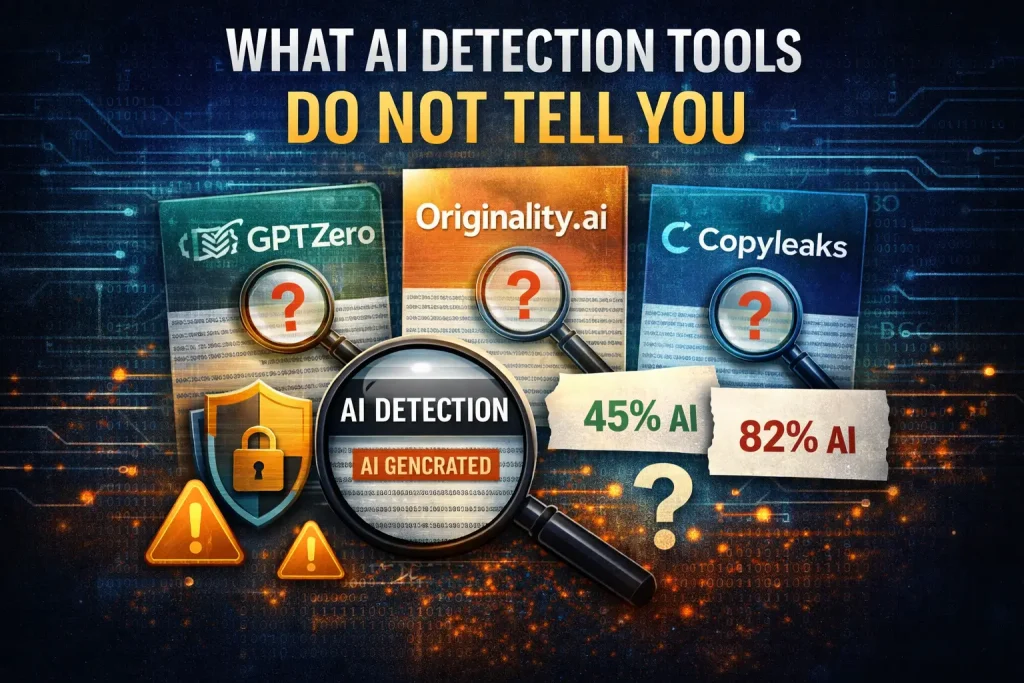
Part 6: What AI Detection Tools Do NOT Tell You
Tool Limitation 1: Humanized Content Bypasses Detection
AI humanizers can make AI content undetectable.
These tools rewrite AI text to sound more human. They remove the patterns detectors look for.
A text humanized once might bypass detection.
A text humanized twice almost certainly will.
This means paid AI detectors might miss content that was intentionally humanized.
Tool Limitation 2: Mixed Content Confuses Tools
Content that is 50 percent human and 50 percent AI confuses detectors.
A writer might use AI for research, then write the article themselves. Or vice versa.
Detectors score this as ambiguous. Tools disagree on whether it is AI or human.
Tool Limitation 3: Different Tools Give Different Results
GPTZero might say 85 percent AI.
Originality.ai might say 40 percent AI.
Copyleaks might say human.
The same text produces different results from different tools.
This is normal. Tools use different detection methods. They have different accuracy rates.
Never rely on a single tool.
Part 7: The Reality of AI Detection in 2026
Here is what you need to accept: Perfect detection is impossible.
AI models are improving. Detectors are improving. But detectors always lag behind.
By the time a detector reliably identifies AI pattern X, AI models have evolved pattern Y.
It is a game of cat and mouse.
The best approach in 2026 is not detection tools alone. It is detection tools plus manual review plus understanding.
A combination of:
Automated tool screening (catches obvious AI)
Manual content review (catches sophisticated AI)
Fact-checking (catches hallucinated claims)
Experience assessment (catches generic content)
No single method catches all AI content. But combining methods catches most.
Part 8: When AI Content Is Okay (And When It Is Not)
AI-generated content is not inherently bad.
What matters is disclosure and purpose.
When AI Content Is Problematic
Student submitting AI-written essays as their own work
Employee claiming to write content they generated with AI
Publisher presenting AI content as human expertise without disclosure
Company using AI to create fake testimonials or reviews
Resume claiming writing skills but using AI
These are deceptive. They violate trust.
When AI Content Is Acceptable
Content marked clearly as “AI-generated with human editing”
Internal documents and drafts using AI for efficiency
Content templates and boilerplate text (no deception about origin)
AI used as a tool with human writing and fact-checking
First draft assistance where human writes the final version
AI used for brainstorming and structure, with human writing the content
These are transparent. No deception involved.
The key is honesty. Tell people if AI helped create content.
Part 9: Why Your Business Needs Detection Capability
If you run a business, you need to detect AI content.
For Hiring
Job applicants lie about qualifications. They use AI for resume writing and cover letters.
You need to know if they actually wrote their submission or if AI did.
For Content Quality
If you hire content creators, you need to verify they are actually writing.
Some freelancers use AI and claim to have written content.
For Brand Reputation
Publishing AI-generated content without disclosure damages trust.
Your audience needs to know your content is from real people.
For Academic Integrity
If you run an educational institution, you need to detect student AI use.
Assignments need to represent student learning, not AI capability.
For Legal Compliance
Some jurisdictions now require disclosure of AI-generated content.
You need detection systems to ensure compliance.
Frequently Asked Questions About AI Detection
Q: Is there a perfect AI detector?
A: No. All detectors have accuracy limits. None are 100 percent reliable. Use tools as a starting point, not final word.
Q: How accurate are paid AI detectors compared to free ones?
A: Paid detectors generally perform better on standard AI text. But all struggle with humanized content. Paid tools offer better support and integration. Free tools work for basic screening.
Q: Can AI tools be used ethically?
A: Yes. AI is a tool. It is ethical to use AI for drafting, editing, research, and brainstorming. It is unethical to use AI without disclosing it. Disclosure is the key.
Q: What should I do if I find AI content in a submission?
A: First, verify with a second tool. Then speak with the author. Give them a chance to explain. They might have used AI ethically. If disclosure should have been made, discuss expectations. If deception occurred, take appropriate action based on your situation.
Q: How is AI detection evolving in 2026?
A: Detection is getting harder as AI gets better at human-like writing. The focus is shifting from detection to disclosure requirements. Some platforms now require creators to label AI-generated content.
Q: Can AI content rank on Google?
A: Yes, but Google’s algorithm favors demonstrable expertise and original insight. AI content alone ranks poorly. AI content edited and fact-checked by humans can rank well. Elite SEO Rankers’ SEO services help ensure your content demonstrates real expertise and ranks effectively.
Q: Should I refuse all AI-generated content?
A: No. Refuse undisclosed AI content. Refuse AI content that is clearly low quality. But AI-assisted content written by humans is normal in 2026 and is acceptable.
Q: How do I build trust around my content in an age of AI?
A: Be transparent about your process. Disclose when AI helped. Show original research and data. Provide personal expertise and examples. Fact-check everything. Get human expertise involved. Trust comes from honesty.
Conclusion: Detection Plus Disclosure
The future is not about banning AI content.
The future is about disclosure.
Readers deserve to know if content was AI-generated. Writers deserve to know if submissions were AI-written. Students deserve honest evaluation of their own work.
Detect AI content when necessary. But prioritize disclosure.
If you use AI to help create content, say so.
If you receive AI-generated submissions, ask about it directly.
If you read AI content, know that you are reading AI.
Transparency builds trust. Deception destroys it.
Your business reputation depends on trust. Your brand reputation depends on knowing what your content really is.
Implement AI detection where it matters. Require disclosure everywhere. Use manual review as the final check.
This is how content credibility survives in 2026.
Need help evaluating your content strategy and ensuring quality in an AI-filled world? Contact Elite SEO Rankers for a consultation. We help businesses create trustworthy, transparent content that ranks and converts.