Introduction: Service Businesses Have a SEO Advantage Nobody Uses
You run a service business. Plumbing. HVAC. Lawn care. Electrical work. Home cleaning. Digital marketing.
When someone needs your service, they search Google. They search “plumber near me” or “best electrician in my area” or “affordable lawn care Denver.”
At that moment, they are deciding who to hire.
If your business appears in their search results, they will consider you. If you do not appear, they will never know you exist.
This is the power of SEO for service businesses. People actively searching for exactly what you offer. Zero cold outreach. Zero convincing. Just showing up at the right moment.
Yet most service businesses do not appear in search results. Why? They do not understand how SEO works for service businesses specifically.
Service business SEO is different from retail. Different from ecommerce. Different from B2B.
Service customers search locally. They search with buying intent. They want to hire someone today or this week. They are not browsing. They are not comparing prices online. They want a real person to solve their problem.
This guide shows you exactly how to position your service business so Google shows you to these customers.
Part 1: Why Service Businesses Have a Natural SEO Advantage
Most service businesses do not realize they have an advantage over other business types.
Think about the search landscape:
Retail stores: Competing with massive brands with huge SEO budgets
Ecommerce: Competing with Amazon and other behemoths
Service businesses: Competing locally with mostly incompetent competitors
Your competition is probably other local service providers. Most of them have terrible websites. Most do not understand SEO. Most are not even trying.
This is your advantage. You do not need to beat Amazon. You need to beat other plumbers in your city. Most of them are not investing in SEO at all.
If you implement a solid local SEO strategy, you will likely outrank 80 percent of your local competitors. Not because you are brilliant. Because they are not doing anything.
This means service business SEO has one of the highest ROIs of any business type. Low competition. High intent. Local customers. Easy wins.
Part 2: Understanding How People Search for Services
Service customers search differently than other customers.
When someone searches for a plumber, they are not doing research. They have a leak. It is happening now. They need someone today.
This is urgent, high-intent search traffic.
The search patterns for service businesses look like this:
Immediate searches (right now):
“Emergency plumber near me”
“Plumber 24/7”
“Plumber open now”
“Urgent drain cleaning”
Near-term searches (this week):
“Plumber in Denver”
“Best plumber in my area”
“Plumber reviews”
“How much does plumbing cost”
Research searches (planning ahead):
“What to look for in a plumber”
“Signs you need a plumber”
“How to prevent plumbing problems”
“Plumbing tips”
You want to rank for all three. But the immediate and near-term searches are where you get actual customers.
Someone doing research three months before they need a plumber might search “how to prevent plumbing problems.” If you rank for this, they might remember you when they need a plumber.
But the person searching “emergency plumber near me” tonight will hire someone tonight. That is your best lead.
Part 3: The Foundation: Google Business Profile for Service Businesses
For service businesses, Google Business Profile is more important than your website.
When someone searches for your service, Google shows them a map with local results. These results come from Google Business Profiles.
A complete, well-maintained Google Business Profile gets you:
Appearing in local search results
Appearing in Google Maps
Direct phone calls from interested customers
Direction requests
Higher visibility than competitors with incomplete profiles
Most service businesses have incomplete Google Business Profiles. They set one up years ago. They never updated it.
This is low-hanging fruit. A complete Google Business Profile often brings more customers than an expensive website redesign.
What A Complete Profile Includes
Business name: Exact match with your legal name
Address: Real physical address (not PO box)
Phone: Business phone line (not personal cell)
Hours: Accurate hours including weekend and emergency availability
Categories: Primary and secondary categories matching what you do
Description: 750-1,500 character description of what you do
Photos: 50-100 photos of your work, team, office, completed projects
Videos: 1-2 short videos introducing your business
Posts: Weekly updates (new projects, special offers, announcements)
Reviews: Request reviews from every customer you work with
Q&A: Answer common customer questions
Service areas: List all neighborhoods you serve
Attributes: Licensed, insured, emergency service, etc.
Why Reviews Matter For Service Businesses
When someone searches for a service, they see reviews prominently.
A plumber with 47 reviews and 4.8 stars gets hired over a plumber with 5 reviews and 4.9 stars. The first one looks more established.
Review count signals how many customers you have served. The rating signals how happy they were.
To get reviews:
After every job, ask the customer for a Google review.
Include a direct link to your Google review (do not make them search)
Text is better than email (higher response rate)
Offer a small incentive if allowed (entry in monthly drawing)
Respond to every review within 24 hours
Negative reviews offer a chance. Respond professionally. Offer to fix the issue. This shows potential customers you care about quality.
Many service businesses get zero reviews. If you get 10, you are already ahead of most competitors.
By 20-30 reviews, you look established. You get hired based partly on authority, not just price.
Part 4: Website Strategy for Service Businesses
Your website is not where service customers primarily find you. But it is where they decide whether to hire you.
They search Google. They see your Google Business Profile. They click your website. They decide: Is this business legitimate?
Your website job is to answer these questions:
Do you serve my area?
Can you solve my problem?
How much does it cost?
How do I contact you?
Can I trust you?
That is it. Service customers do not want to read 50 pages. They want basic information and a way to contact you.
Essential Pages for Service Websites
Homepage: Who you are, what you do, service areas, call to action
Services page: Each service you offer, how it helps, why you are good at it
Service area pages: One page per neighborhood or area you serve
About page: Your team, experience, credentials, why customers should hire you
Reviews/testimonials page: What past customers say about you
Contact page: Phone, email, contact form, hours
Blog section: Articles answering customer questions (optional but helpful)
Service Area Pages (Your Secret Weapon)
Most service businesses have one “service areas” page listing all neighborhoods.
Better approach: Create one dedicated page per neighborhood you serve.
Example:
yoursite.com/services/denver-plumbing
yoursite.com/services/highlands-plumbing
yoursite.com/services/lakewood-plumbing
Each page targets that neighborhood specifically. It talks about that neighborhood. It has reviews from that neighborhood. It ranks for that neighborhood.
Instead of competing for “Denver plumbing” (very competitive), you rank for “Highlands plumbing” (less competitive).
With 10 service areas, you have 10 ranked pages. That is 10 neighborhoods where customers search and find you.
Most service businesses do not do this. They miss the opportunity.
Website Speed and Mobile (Critical)
Service customers search on phones. They are standing in their kitchen with a burst pipe. They search on phone. Your website needs to work perfectly on mobile.
Website speed matters. A slow website loses customers. Test your speed at Google PageSpeed Insights. Fix the problems it identifies.
Part 5: Content That Brings Service Customers
Service businesses think they do not need content. “I provide a service. What am I going to write about?”
Actually, service customers search for information all the time.
Examples:
“How do I know if I need a plumber?”
“What are signs of a bad HVAC system?”
“When should I replace my roof?”
“How often should I clean my gutters?”
“What causes foundation problems?”
Content answers these questions. It brings traffic. It builds trust. It ranks on Google.
You are the expert. Share your expertise. Write about problems you solve every day.
Content ideas:
How-to guides (How to prevent plumbing problems)
Problem identification (Signs you need AC repair)
Cost guides (How much does a roof replacement cost)
Comparison articles (Roofing material comparison)
Common mistakes (Mistakes people make with their lawn care)
Seasonal content (Winter HVAC maintenance, spring lawn tips)
Customer stories (Case study of a difficult job you solved)
Industry trends (Changes in plumbing codes, new HVAC technology)
One article per month is plenty. Two per month is great. Consistency matters more than frequency.
Each article should naturally link to your service pages. Not forced. Just relevant links.
“If your foundation shows these signs, contact us for an inspection.”
Content drives traffic. Traffic turns into leads.
Part 6: Local SEO Fundamentals for Service Businesses
Local SEO is how service businesses rank on Google Maps and local search.
Local SEO involves:
Google Business Profile optimization (covered in Part 3)
Service area pages (covered in Part 4)
Local keywords (covered in Part 7)
Reviews and ratings (covered in Part 3)
Citations (business mentions online)
Local backlinks (links from local organizations)
Mobile optimization (covered in Part 4)
Most of this you control. You can do it yourself.
Citations are mentions of your business on other websites. Directories, industry sites, local organizations.
Build citations by:
Getting listed in local business directories
Listing in industry-specific directories (plumbers, electricians, contractors)
Joining local chambers of commerce
Sponsoring local events or nonprofits
Getting mentioned in local news or blogs
Citations signal to Google that you are a real, established local business.
Quality matters more than quantity. One citation from a high-authority local site beats 20 citations from low-quality directories.
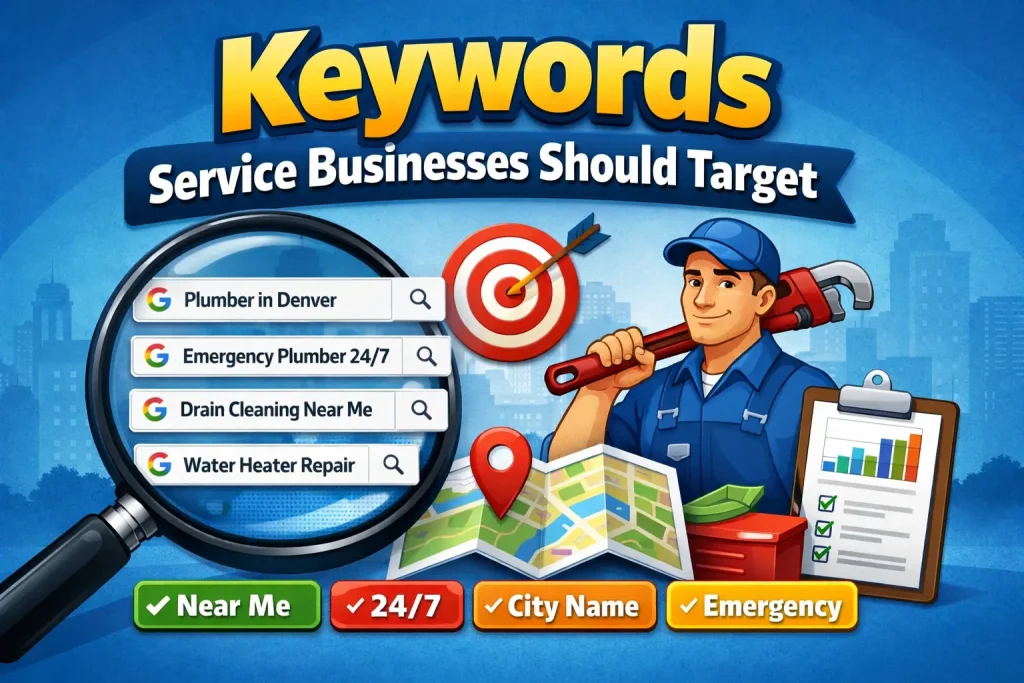
Part 7: Keywords Service Businesses Should Target
Service businesses have specific keywords they should target.
Do not target generic keywords. Target local, specific keywords.
Bad keywords:
“Plumbing services”
“Best plumber”
“Plumbing company”
Good keywords:
“Plumber in Denver”
“Emergency plumber 24/7”
“Drain cleaning Denver”
“Residential plumbing services Denver”
“Water heater replacement near me”
The good keywords tell Google exactly what you do and where you do it.
Your target keywords should include:
Service name + location (“plumber Denver”)
Service name + area (“plumber in Highlands”)
Service name + type (“emergency plumber”)
Service name + problem (“clogged drain plumber”)
Service + “near me”
Service + “24/7” or “emergency” if applicable
Keyword Research For Service Businesses
Use Google Keyword Planner or similar tool. Search your main service.
Look for keywords that:
Include your location or “near me”
Have search volume (people searching)
Have low competition (you can rank)
Match your service exactly
Do not target generic keywords you cannot win. Target neighborhood-specific keywords you can win.
Example: A plumber in Denver targets “plumber Denver” (high competition). Better to target “plumber in Highland Park” or “emergency plumber West Denver” (lower competition).
Part 8: Converting Traffic Into Leads
Getting traffic is not enough. You need traffic to convert into leads.
Service business conversion usually means:
Phone call
Contact form submission
Text message inquiry
Email inquiry
Chat inquiry
Make it easy for people to contact you.
Clear Call-to-Action
Every page should have clear call-to-action.
“Call Now: [Phone Number]”
“Schedule Free Inspection”
“Get Free Quote”
“Contact Us Today”
Do not hide your contact information. Make it obvious and easy.
Include your phone number in multiple places:
Header of every page
Contact page
Google Business Profile
Service pages
Mobile visitors should be able to click your phone number and call directly.
Contact Forms (Optional but Helpful)
Some visitors prefer submitting a form instead of calling.
Simple contact forms work best. Ask only what you need:
Name
Phone
Service needed
Message (optional)
Long forms with 20 questions lose people. Short forms get submissions.
After they submit, follow up quickly. Same day if possible. Next morning at latest.
Part 9: Tracking What Actually Works
Most service businesses do not track conversions. They do not know which marketing brings customers.
You need to know:
How many people visit your website
Where they come from (Google, Maps, direct, ads)
Which pages they visit
Whether they call or submit a form
Whether they become paying customers
This information guides your strategy. You double down on what works. You stop doing what does not work.
Setting Up Tracking
Google Analytics: Shows website traffic and behavior
Google Search Console: Shows which keywords drive traffic
Phone tracking: Forward your business phone through a system that shows which traffic source the call came from
Contact form tracking: Know which pages generate form submissions
Customer surveys: Ask new customers “How did you find us?”
This data tells you what is working. Maybe 80 percent of your leads come from Google Maps. Maybe 20 percent come from your website. Maybe 10 percent come from referrals.
Knowing this lets you invest more in what works.
Part 10: Quick Wins for Service Businesses
You do not need perfect SEO to start getting customers. You need the basics right.
Quick wins:
Complete your Google Business Profile fully (1-2 hours)
Request reviews from past 10 customers (2-3 hours)
Create service area pages for your top 3 neighborhoods (4-6 hours)
Post once weekly on Google Business Profile (30 minutes weekly)
Fix your website speed (1-2 hours with a developer)
Add clear call-to-action to every page (1 hour)
These are not complicated. They take maybe 10-15 hours total. But they produce results.
Many service businesses still do not do these basics. If you do them, you are ahead of your competition.
Part 11: Timeline For Service Business SEO
When will you see results?
Month 1: Complete profile, request reviews, create service area pages. Foundation building.
Month 2: First reviews appear, Google Business Profile gets more visibility, website improvements live.
Month 3: Start seeing phone calls from Google Maps, website traffic increases slightly.
Month 4-6: Consistent phone calls from Google Maps and website, service area pages start ranking.
Month 6-12: Established presence in local search, steady customer flow from organic search.
Month 12+: Market leader status in your area, consistent lead generation.
Service business SEO has short timelines compared to other industries. You can see phone calls in month 3-4.
This is not ecommerce waiting 12 months for sales. This is getting actual leads within weeks.
Frequently Asked Questions
Q: Do I really need a website if I have Google Business Profile?
A: Google Business Profile gets you the initial phone call. Your website confirms you are legitimate. People often visit your website before calling. You need both.
Q: How many service area pages should I create?
A: Create pages for neighborhoods where you actively work. Quality beats quantity. 5-10 pages is typical for local service businesses.
Q: Can I do this myself or do I need a professional?
A: You can do most of this yourself. Google Business Profile optimization, service area pages, reviews, local content. Hiring a professional helps with strategy and speeds up results. Elite SEO Rankers’ local SEO services guide service businesses through this process.
Q: What if my competitors are already ranked?
A: Established rankings take time to displace. But if competitors are not actively maintaining their SEO, you can outrank them with consistent effort. Service business SEO has lower competition than other industries.
Q: How much does local SEO for service businesses cost?
A: DIY costs nothing except time (10-15 hours per month). Hiring someone ranges from $500-2,000 monthly depending on services. Most service businesses see ROI quickly because customer lifetime value is high.
Q: Should I do Google Ads while building organic SEO?
A: Yes. Google Ads brings immediate leads while SEO builds. By month 6, reduce ads as organic traffic grows. Both together accelerate results.
Q: How important is content marketing for service businesses?
A: Content helps but is not required. Service area pages and Google Business Profile are more important. Content amplifies results and builds authority. Start with the basics first.
Q: What if I serve a huge area?
A: Create service area pages for your primary areas. Do not try to cover 50 neighborhoods. Focus on 5-10 neighborhoods where you are strongest. Dominate these areas first.
Q: How do I compete with big national brands?
A: You do not compete nationally. You compete locally. Local customers prefer local businesses. Your advantage is being local. Use it.
Q: Can I rank for multiple service types?
A: Yes. Create separate pages for each service. “Plumbing,” “water heater installation,” “drain cleaning,” “emergency service.” Each gets its own page.
Conclusion: Your Service Business SEO Action Plan
Service business SEO is simpler than you think. You do not need a complicated strategy.
Start with these steps:
Week 1: Complete your Google Business Profile fully
Week 2: Request reviews from past 10 customers
Week 3: Create service area pages for your top 3 areas
Week 4: Start weekly Google Business Profile posts
Month 2: Set up tracking on your website
By month 3, you will have phone calls coming from Google. Real customers searching for exactly what you offer.
By month 6, Google will be a major source of leads for your business.
This is not complicated. It is not expensive. It just requires doing the basics right and being consistent.
Your competitors probably are not doing this. They think SEO is too complicated. This is your competitive advantage.
Ready to get service customers searching for you on Google? Contact Elite SEO Rankers for a free consultation. We help service businesses establish local dominance through Google rankings.
Start this week. Every week you wait, your competitors get a chance to outrank you.